 By Pamela Rose
The modern highway is a diverse ecosystem where vehicles of all shapes and sizes must coexist. Among the most vulnerable road users are motorcyclists. While a traditional passenger car or sport utility vehicle surrounds occupants with steel cages, airbags, and crumple zones, a motorcycle rider relies solely on protective apparel and defensive riding strategies for safety.
Because of their smaller profile and distinct operating characteristics, motorcycles are frequently misjudged or completely overlooked by drivers. Statistics consistently reveal that a significant percentage of multi-vehicle accidents involving motorcycles occur because a passenger vehicle driver failed to perceive the two-wheeled vehicle in time. Ensuring safety on public roads is a shared responsibility. By understanding motorcycle behavior and adapting your driving habits, you can play a crucial role in preventing tragic collisions.
The Psychology and Physics of Visual Perception
To share the road safely with motorcycles, a driver must first understand why these vehicles seem to disappear in traffic. This phenomenon is deeply rooted in human visual psychology and is often referred to as inattentional blindness.
The human brain is constantly bombarded with sensory information while driving. To prevent cognitive overload, the brain filters out data it deems irrelevant, focusing instead on larger threats like commercial trucks and other cars. Because motorcycles are significantly smaller than passenger vehicles, the brain can subconsciously fail to recognize them as an approaching vehicle, especially at busy intersections.
Furthermore, judging the speed and distance of a motorcycle is incredibly difficult. Due to their narrow profile, motorcycles do not seem to grow in size as rapidly as a car when they approach, which often leads drivers to underestimate how fast a rider is moving. Assuming a motorcycle is farther away than it actually is can lead to catastrophic errors when turning or changing lanes.
Mastering Crucial Intersections and Left-Turn Scenarios
Intersections are the single most hazardous environment for motorcyclists. According to traffic safety data, the most common multi-vehicle crash configuration occurs when a passenger vehicle makes a left turn directly in front of an oncoming motorcycle.
Double-Check Before Making a Left Turn
When you are waiting at an intersection to make a left turn, look past the oncoming cars. A motorcycle can easily be completely hidden behind a larger vehicle, such as a delivery van or a pickup truck. Before accelerating through the turn, look twice specifically for the narrow silhouette of a motorcycle. If you spot an oncoming rider, wait for them to pass rather than attempting to squeeze ahead of them.
Allow Extra Time at Stop Signs
When pulling out from a side street, stop sign, or driveway, take an extra moment to scan the roadway. Because a motorcycle can be easily obscured by roadside infrastructure, utility poles, or trees, a quick glance is often insufficient. Implement a deliberate scanning technique, looking far left, center, then far right before entering the flow of traffic.
Maintaining Safe Following Distances and Space Cushions
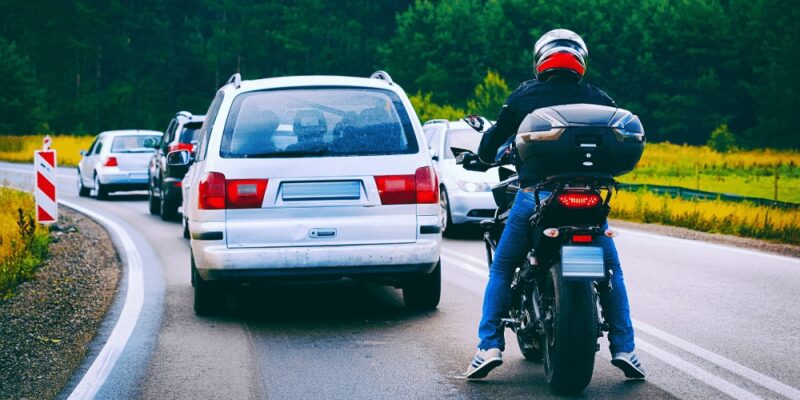
Tailgating is a dangerous driving habit under any circumstance, but when directed at a motorcycle, it can quickly become fatal. Motorcyclists require unique spatial considerations due to how their vehicles handle the road.
The Four-Second Rule
While a two-second following distance might be acceptable in ideal conditions behind a passenger car, you should increase this cushion to at least four seconds when following a motorcycle. If the rider encounters a sudden hazard or falls from their bike, a larger space cushion gives you the necessary time to react and stop your vehicle without running over the rider.
Understand Braking Differences
Motorcycles can decelerate much quicker than passenger cars because they carry significantly less mass. Furthermore, riders frequently slow down by downshifting their transmission or releasing the throttle, a process known as engine braking. When a rider uses engine braking, the motorcycle slows down rapidly without activating the rear brake light. If you are following too closely, you may not realize the motorcycle is stopping until it is too late.
Navigating Blind Spots and Changing Lanes Safely
Every passenger vehicle features physical blind spots where the mirrors fail to reflect surrounding traffic. Because of their compact size, motorcycles can linger in these blind spots completely undetected for extended periods.
Perform Physical Head Checks
Relying solely on your rearview and side mirrors is never enough when changing lanes or merging onto a highway. Always perform a physical head check by looking over your shoulder toward the lane you intend to enter. This quick action ensures you detect any hidden motorcyclists who might be riding alongside your rear quarter panel.
Signal Your Intentions Early
Always activate your turn signal several seconds before you begin moving the steering wheel. Signaling early gives a nearby motorcyclist the opportunity to adjust their position, honk their horn, or flash their lights if you are inadvertently moving into their path. Never execute sudden, unannounced lane changes.
Recognizing Road and Environmental Challenges for Riders
A minor road imperfection that a car driver barely feels can be a life-threatening obstacle for a motorcyclist. Understanding what causes a rider to adjust their path will help you anticipate their movements.
-
Potholes and Road Debris: Motorcyclists must actively avoid potholes, gravel patches, oil spills, and dead animals. If a rider encounters these hazards, they will often swerve within their lane. Expect this behavior and avoid crowding them.
-
Weather and Wet Surfaces: Rain, wind, and low temperatures affect motorcycles profoundly. Wet road markings, manhole covers, and metal bridge expansion joints become incredibly slick for two wheels. In inclement weather, give riders even more space, as their traction is severely compromised.
-
Railroad Crossings and Grooved Asphalt: To safely cross railroad tracks or construction zones with grooved pavement, riders often need to align their motorcycle perpendicular to the tracks or grooves. This may cause them to slow down abruptly or change direction within the lane.
Respecting the Integrity of the Entire Lane
A motorcycle is legally entitled to the full width of a standard traffic lane, just like any other motor vehicle. Never attempt to share a single lane with a motorcycle, even if the rider is hugging one side of the lane.
Passing a motorcycle within the same lane is highly dangerous. The wind blast generated by a car or truck passing too closely can create strong aerodynamic turbulence that can easily destabilize a motorcycle, pushing the rider off balance or off the road entirely. When overtaking a motorcycle, move completely into the adjacent lane to pass, ensuring you leave a wide berth before moving back into their lane.
By developing a heightened sense of visual awareness, respecting the rider’s space, and anticipating their reactions to environmental hazards, you create a significantly safer driving environment for everyone sharing the highway.
Frequently Asked Questions
Why do motorcyclists sometimes ride on the line between lanes or split traffic?
Lane splitting or lane filtering is a practice where motorcyclists ride between rows of stopped or slow-moving vehicles. In many jurisdictions, this maneuver is legal and is utilized to reduce traffic congestion and protect riders from being rear-ended in stop-and-go traffic. When a motorcycle is sandwiched between cars during a rear-end collision, the injuries are often severe. Lane filtering allows riders to move to the front of a queue safely.
Is it safe to flash my high beams to let a motorcyclist know they can turn in front of me?
No, flashing your high beams can be highly dangerous. The bright, sudden burst of light can temporarily blind a motorcyclist or obscure their view of other oncoming hazards. Additionally, flashing your lights can be misinterpreted by the rider or other nearby drivers, leading to confusion about who has the right of way. It is always safer to use standard, predictable driving actions rather than informal light signals.
Why do some motorcycles have their headlights on during the middle of a bright day?
Most modern motorcycles are manufactured with automatic always-on headlight systems. Because motorcycles have a narrow visual profile that makes them difficult to see against complex background environments, an illuminated headlight drastically improves daytime conspicuity. This continuous illumination helps oncoming drivers perceive the motorcycle much sooner than they would otherwise.
What should a driver do when a group of multiple motorcycles is traveling together on the highway?
When encountering a group ride, maintain a steady speed and avoid merging into the middle of their formation if possible. Large groups often ride in a staggered pattern to maximize their visibility and braking space. If you must enter their lane to take an exit, signal early and wait for a clear, large gap. Do not tail-gate the rear riders or attempt to race past the formation.
Why do motorcyclists weave side to side within their own lane when there are no obvious obstacles?
Riders may adjust their lateral position within a lane for several strategic reasons. They might be changing positions to avoid riding in the oily center of the lane where cars drop fluids, or they may be positioning themselves to remain visible in the side mirrors of the vehicle ahead of them. Occasionally, a rider will gently weave to scan around a large truck to see upcoming traffic conditions.
How does the wind generated by large commercial trucks or SUVs affect an adjacent motorcyclist?
Large, boxy vehicles push a massive volume of air forward and outward as they travel at highway speeds, creating a bow wake of turbulent air. When a car or truck passes a motorcycle closely, this high-pressure air wave can physically shove the motorcycle sideways. Understanding this aerodynamic effect means drivers should maximize lateral distance when passing a rider on the highway.